
Spirituality
Sphatik and Lord Shiva: A Sacred Connection
Explore the deep spiritual bond between Sphatik and Lord Shiva, from ancient scriptures to everyday worship — and how to choose an authentic Sphatik Shivling for your home.
Spirituality
Explore the deep spiritual bond between Sphatik and Lord Shiva, from ancient scriptures to everyday worship — and how to choose an authentic Sphatik Shivling for your home.
In Hindu tradition, Lord Shiva is worshipped in many forms. As the cosmic dancer Nataraja. As the meditating ascetic on Mount Kailash. As the compassionate Bholenath who is easily pleased by sincere devotion.
But among all the materials used to represent Shiva in the form of a Shivling, Sphatik — natural clear quartz crystal — holds a place that is widely regarded as exceptionally sacred.
Why Sphatik, specifically? Why has this clear, colourless crystal been connected to Lord Shiva across centuries of Indian tradition?
This article explores that question — through scripture, symbolism, and the living tradition of Shiva worship that continues in homes and temples across India today.
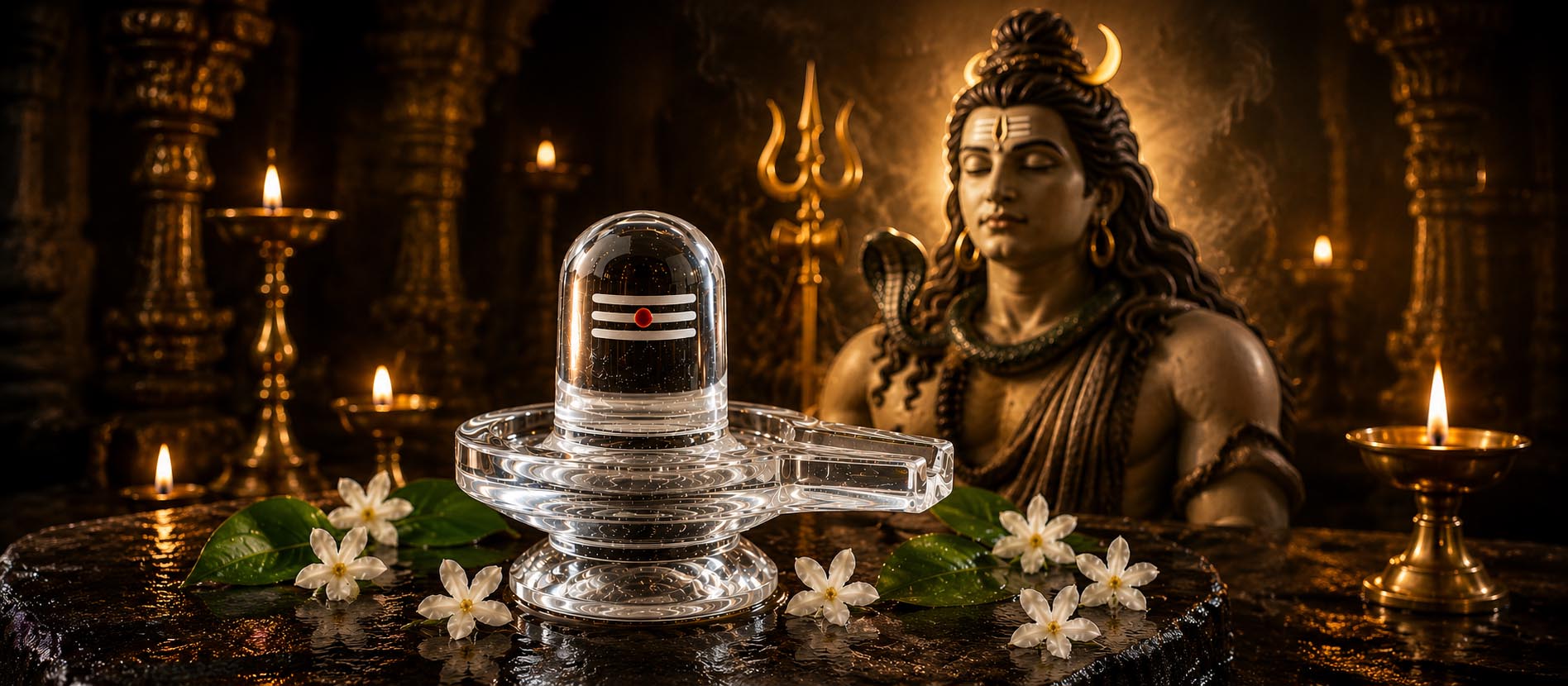
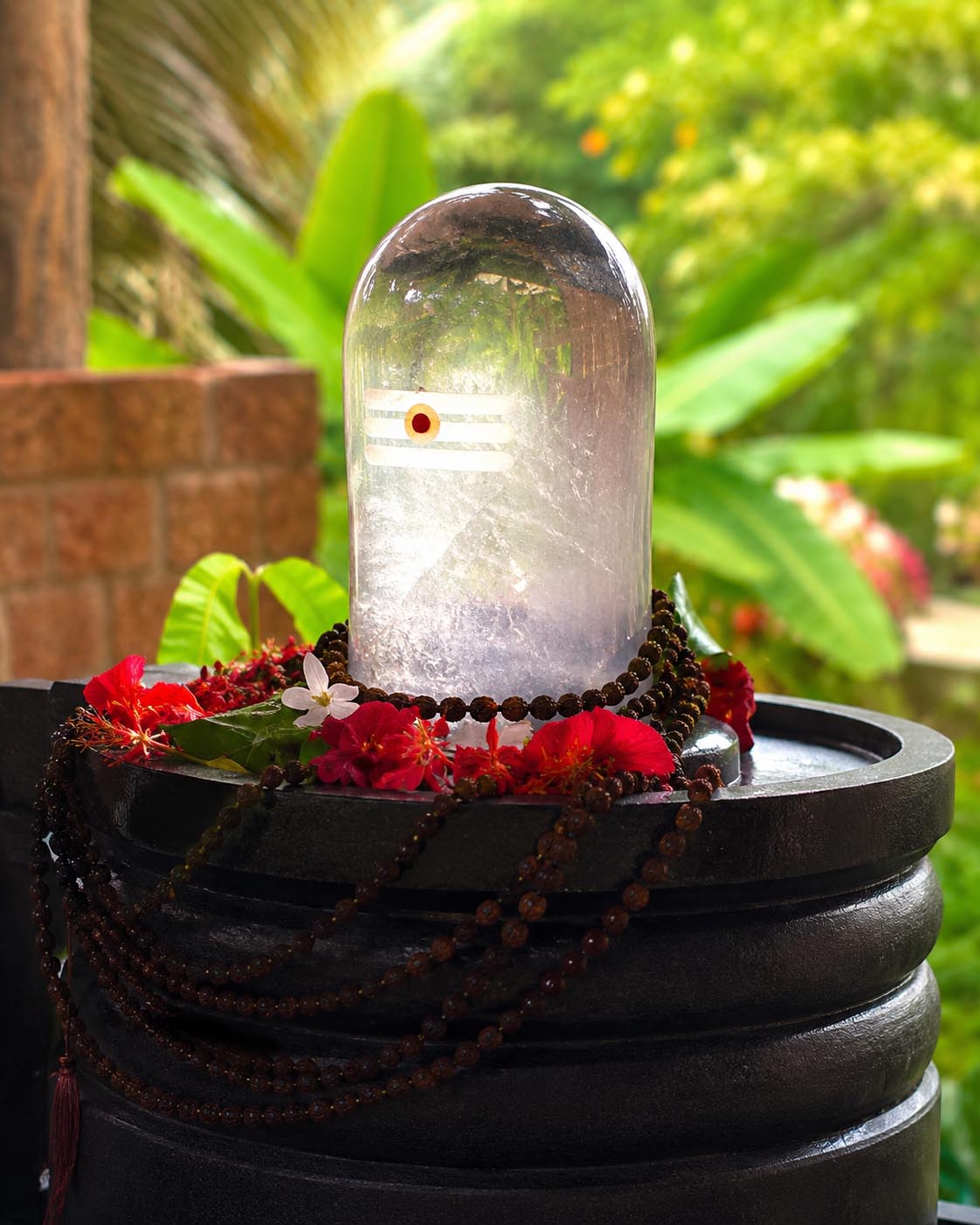
A Sphatik Shivling is a Shivling — the elliptical form in which Lord Shiva is traditionally worshipped — shaped from natural Sphatik (clear quartz crystal).
The Shivling itself has deep spiritual meaning in Shaivism. It represents Lord Shiva in his formless, attributeless state, what the scriptures call Nirguna Brahman, the Supreme Self that is beyond form, colour, and qualities. It symbolises the union of Shiva and Shakti, of consciousness and energy, that underlies all of creation.
The Sphatik Shivling brings these ideas together with the natural qualities of clear quartz: transparency, colourlessness, and purity of appearance. A material that, like Shiva himself, has no colour of its own, but reflects everything it comes in contact with.
If you are considering bringing one into your home, start with our guide on the benefits of a Sphatik Shivling — it covers what devotees traditionally expect from daily worship and why this form of Shiva has remained so popular in family mandirs.
The connection between Sphatik and Lord Shiva isn't recent. It is mentioned in some of the oldest and most revered texts in Hindu tradition.
The Linga Purana describes Lord Shiva's primordial form as shuddha-sphatika, the pure, effulgent crystal that is devoid of attributes, taintless, and undisturbed. In this description, Sphatik isn't just the material of a Shivling — it is used as a direct metaphor for Shiva's divine nature: clear, pure, and free from all limitation.
The Yajur Veda refers to Lord Shiva as Jyothi Spatika Lingam, the Lingam that is light and crystal combined. The image is of a column of pure, radiant light that is simultaneously the formless Shiva and the transparent crystal that best represents him in physical form.
The Saiva Agamas, ancient texts that guide temple worship and ritual across South India, specifically mention that among all the materials a Shivling can be made from — including stone, metal, earth, and wood — the Sphatik Shivling is considered the purest. The Agamas note that Sphatik is not carved by man but made by nature, grown molecule by molecule over long periods of time, and that this natural origin itself makes it especially fit for worship.
The Shiva Purana describes Lord Shiva as having revealed himself to his devotees in the form of a column of radiant light, known as the Jyotirlinga. The Sphatik Shivling is widely regarded as the closest physical representation of that radiant, luminous presence.
Across all these texts, a few ideas keep coming up. Together, they explain why Sphatik and Lord Shiva became so deeply associated in Indian tradition.
Sphatik has no colour of its own. It takes on the appearance of whatever surrounds it, reflecting light, colour, and environment without holding onto any of it. This mirrors the concept of Nirguna, the quality of being without attributes, which is one of the most important ways Shiva is described in the scriptures. A Sphatik Shivling, by its very nature, represents a deity who is beyond all form and definition.
Sphatik is natural, not man-made. This matters in the traditional understanding of sacred objects. Sphatik is formed deep within the Earth over an enormous span of geological time, without human intervention. The Saiva Agamas specifically value this. A Shivling made of Sphatik carries the quality of being genuinely a creation of nature, which aligns with Shiva's own identification with the natural world — with forests, mountains, rivers, and the cosmos itself.
Sphatik doesn't need Prana Pratishtha. This is one of the most practically significant beliefs in Sphatik Shivling worship. According to traditional understanding, most ritual objects need a formal consecration ceremony (Prana Pratishtha) before they can be worshipped as a divine presence. A Sphatik Shivling is traditionally considered to not require this, because its natural purity is already complete. This makes it accessible for home worship without elaborate ritual prerequisites.
Sphatik is considered eternally pure (Ashuddhata rahit). In traditional belief, Sphatik cannot become ritually impure. This makes it ideal for daily worship, especially in a home setting where absolute ritual purity may be difficult to maintain at all times.
The Sphatik Shivling isn't only found in homes. Some of India's most ancient and revered Shiva temples are associated with Sphatika Lingams.
Thillai Nataraja Temple, Chidambaram (Tamil Nadu) is one of the most celebrated Shiva temples in India. Lord Shiva here is worshipped as Nataraja, the cosmic dancer, and the temple has ancient associations with a Sphatika Lingam in its sanctum.
Ramanathaswamy Temple, Rameshwaram (Tamil Nadu), one of the twelve Jyotirlingas, is said to have a Sphatika Lingam among its sacred objects of worship.
Meenakshi Amman Temple, Madurai similarly has associations with a Sphatika Lingam, where Shiva is worshipped as Sundareswara.
These associations are traditionally documented and point to the long history of Sphatik as a sacred material in the living worship traditions of South India particularly, though Sphatik Shivlings are found in temples and homes across the country.
In temple worship, priests traditionally offer abhisheka — ritual bathing with milk, water, honey, and other sacred substances — directly to the Sphatik Shivling. The Om Namah Shivaya mantra is chanted 108 times as part of this offering. The transparency of Sphatik makes it visually striking during abhisheka — the liquid offerings seem to flow through the crystal itself.
Many devotees who worship a Sphatik Shivling at home also keep a Sphatik Mala for chanting the Panchakshari Mantra during puja. The Shivling becomes the focal point of worship; the mala becomes the tool for japa.
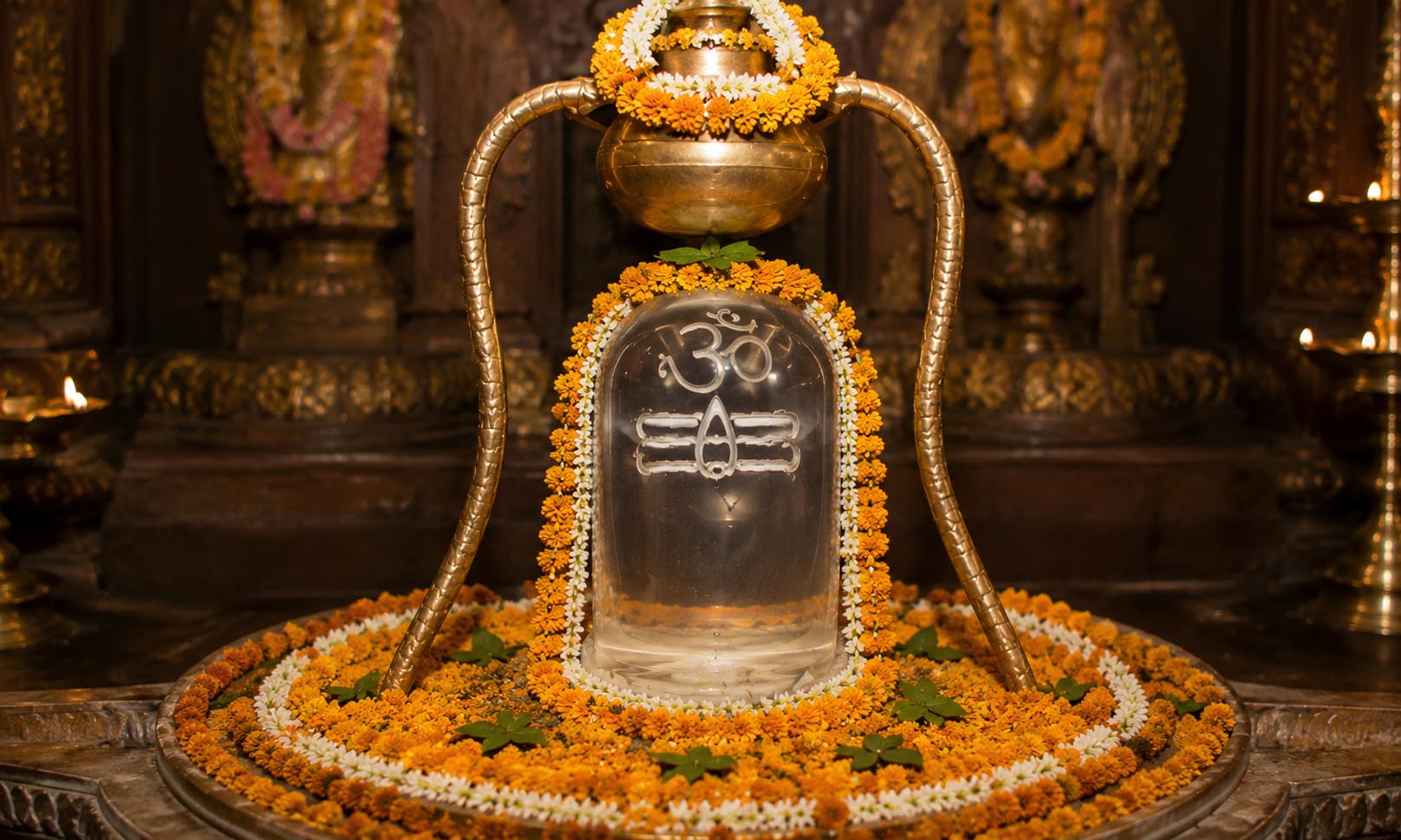
For many Indian families, the Sphatik Shivling is a centrepiece of their home puja space.
One of the reasons it is so widely used for home worship is the traditional belief that its purity is inherent and constant. It doesn't require elaborate consecration. It can be worshipped by all members of the household. There are no restrictions related to gender or caste in Sphatik Shivling worship — a point that traditional sources consistently emphasise.
In daily puja, the Sphatik Shivling is typically:
Placed facing East or North
Bathed with water or milk during abhisheka
Offered fresh flowers, particularly white flowers traditionally associated with Shiva
Kept on a clean surface or brass/copper plate
The simplicity of Sphatik Shivling worship aligns well with Shiva's own nature as Bholenath, the easily pleased one who values sincere devotion over elaborate ritual.
There's something philosophically elegant about the relationship between Sphatik and Lord Shiva that goes beyond ritual instruction.
Shiva, in the deepest understanding of the Shaiva tradition, is not a deity who can be contained in a single form or description. He is formless and yet present everywhere. He is the meditating ascetic and the cosmic dancer. He is the destroyer and the regenerator. He is both Saguna (with qualities) and Nirguna (without qualities).
Sphatik, as a material, carries a similar quality. It has no inherent colour yet holds the capacity to reflect all colours. It is solid yet appears almost liquid in its transparency. It is formed by nature over an inconceivable span of time yet sits quietly in the palm of your hand.
In this sense, Sphatik doesn't just represent Shiva. It embodies, in a small and humble way, the same kind of paradox that Shiva himself represents: something completely natural, completely simple, and yet pointing toward something that exceeds ordinary understanding.
The spiritual significance of a Sphatik Shivling only matters if the crystal itself is genuine.
Unfortunately, the market is full of glass and synthetic imitations sold as Sphatik. They look similar at first glance — clear, smooth, polished — but they are not natural quartz. For something you will worship every day, possibly for decades, that difference matters.
A genuine Sphatik Shivling will usually show:
Slight natural inclusions or internal texture visible when held to light
A cool, dense feel in the hand — heavier than glass of the same size
Minor variations in clarity that indicate natural formation, not factory uniformity
Before you buy, read our guide on how to identify original Sphatik. It walks through the simple checks you can do at home to tell natural quartz from glass.
At Sphatik, every Shivling in our collection is made from natural clear quartz — sourced, inspected, and verified before it reaches you. No glass. No synthetic substitutes. Just the real crystal that tradition has associated with Lord Shiva for centuries.
If this article has helped you understand why Sphatik and Lord Shiva are so deeply connected, the natural next step is finding a Shivling you can trust.
Whether you are:
Setting up your first home mandir
Replacing an old Shivling passed down through the family
Looking for a meaningful gift for someone beginning their Shiva sadhana
Simply drawn to the calm, clear presence of natural crystal on the altar
…a genuine Sphatik Shivling is one of those purchases you make once and keep for years.
Browse our Sphatik Shivling collection — natural quartz, verified for authenticity, crafted for daily worship.