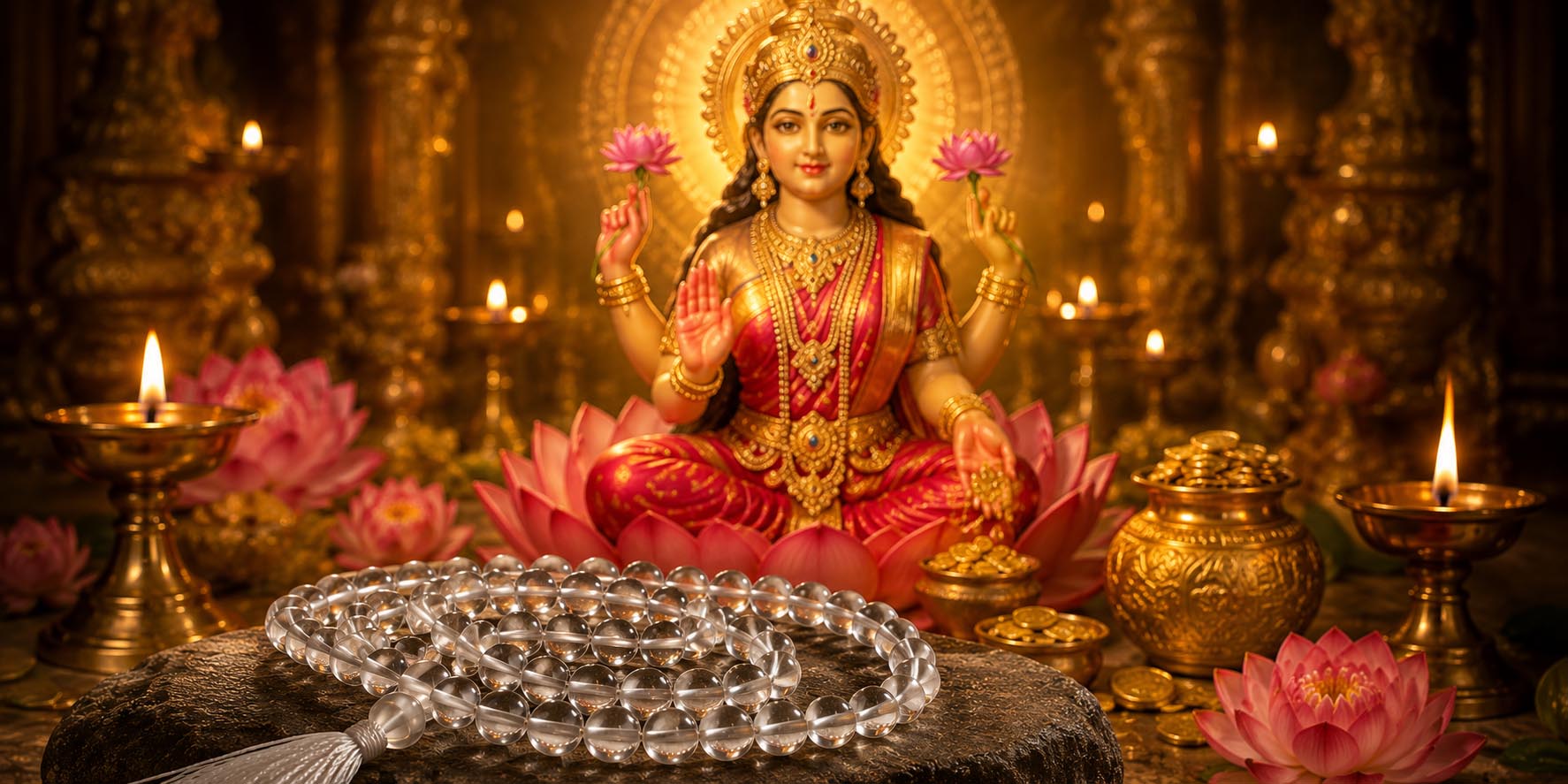
Explore the deep spiritual connection between Sphatik crystal and Goddess Mahalakshmi — from ancient scripture to daily worship — and why Sphatik Mala is considered the most auspicious tool for Lakshmi Sadhana.
10 min read • Updated June 2026
In every Lakshmi temple in South India, and in countless home mandirs across the country, you will find a Sphatik Mala near the deity.
Not because it is the most expensive thing on the altar. Not because someone told them to put it there recently. But because it has always been there — used by grandmothers, passed to daughters, worn on Friday mornings during puja since as far back as anyone in the family can remember.
The connection between Sphatik and Goddess Mahalakshmi is one of the oldest and most constant threads in Indian devotional tradition. This article explains where it comes from, what it means, and how people have used it for centuries to invite Lakshmi's blessings into their homes and lives.
Who Is Mahalakshmi?
Mahalakshmi is one of the most widely worshipped goddesses in India. She is the goddess of wealth, prosperity, auspiciousness, beauty, and abundance. She is the consort of Lord Vishnu and is regarded as the Shakti — the divine feminine energy — that sustains and nourishes all of creation.
The name Mahalakshmi comes from the Sanskrit word Lakshya, meaning aim or goal. She is the goddess of everything you are working toward — not just money, but also health, family happiness, spiritual growth, and inner fulfilment.
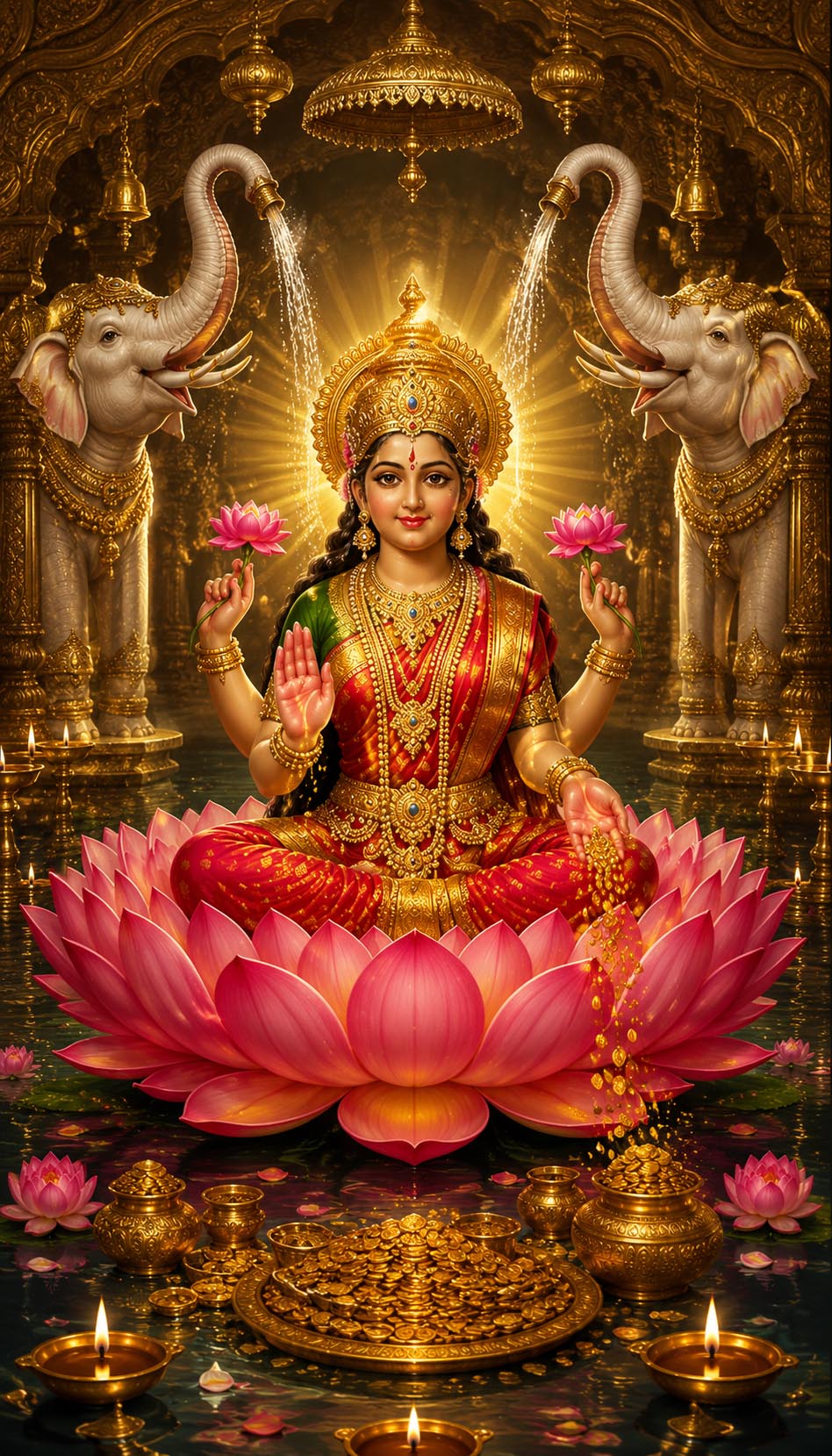
She is depicted seated on a full lotus, wearing gold and red, with four arms holding lotus flowers and showering gold coins. Two white elephants stand on either side, pouring sacred water over her. Every element of this image speaks to abundance — not grasped or hoarded, but freely flowing.
The Eight Forms of Mahalakshmi
Mahalakshmi is also worshipped as Ashta Lakshmi — eight divine forms, each governing a different kind of wealth:
Dhana Lakshmi — material wealth and money
Dhanya Lakshmi — food, harvest, and nourishment
Santana Lakshmi — children and family
Gaja Lakshmi — power, strength, and elephants (symbols of royal abundance)
Veera Lakshmi — courage and strength to face life's challenges
Vijaya Lakshmi — victory in all endeavours
Vidya Lakshmi — knowledge, learning, and wisdom
Aadi Lakshmi — the eternal, timeless form of Lakshmi as primordial goddess
Worshipping Mahalakshmi through a Sphatik Mala is traditionally believed to invite all eight of these forms of abundance simultaneously.
Why Sphatik Is Sacred to Mahalakshmi
The connection between Sphatik and Mahalakshmi is rooted in Vedic tradition and supported by ancient scripture.
Sphatik Mala is mentioned in texts connected to Lakshmi Sukta — one of the most important Vedic hymns dedicated to Goddess Lakshmi, found in the Rigveda. Traditional Lakshmi Sadhana has long included the Sphatik Mala as the primary mala for chanting the Lakshmi Sukta and other Lakshmi mantras.
Ancient Siddha sages are said to have consecrated Sphatik Mala specifically with Lakshmi Sukta mantras during Chandra Grahan (lunar eclipse) — a time considered especially powerful for spiritual practices — so that its blessings could be received by ordinary devotees in everyday worship.
Friday (Shukravar) is Mahalakshmi's day. It is also the day of Venus (Shukra) in Vedic astrology. Sphatik carries the energy of Venus — beauty, grace, abundance, love — which is also the energy that Mahalakshmi embodies. This natural overlap is why Sphatik and Mahalakshmi are so deeply linked in both devotional and astrological tradition.
Sphatik and the Varalakshmi Vrat
One of the most important Lakshmi festivals in India is Varalakshmi Vratam — observed on the Friday before the full moon in the month of Shravana (July–August). This festival is especially celebrated in Tamil Nadu, Karnataka, Andhra Pradesh, Telangana, and Maharashtra.
Vara means boon. Varalakshmi is the form of Mahalakshmi who grants boons to her devotees. Worshipping her on this day is traditionally said to be equal to worshipping all eight forms of Ashta Lakshmi.
In the Skanda Purana, the story of Varalakshmi Vratam begins with Goddess Parvati asking Lord Shiva which vrat was most beneficial for women and their families. Lord Shiva describes the Varalakshmi Vratam and its merits.
The Sphatik Mala is one of the two primary malas recommended for chanting during Varalakshmi Vratam, alongside the Kamalgata (lotus seed) mala. This is not a recent addition — it is part of the traditional practice itself, mentioned in ritual guides and passed down through generations of South Indian families.
Lakshmi Sadhana With Sphatik Mala
Lakshmi Sadhana refers to a devoted, consistent practice of Lakshmi worship — going beyond occasional puja to a regular, personal spiritual discipline.
The Sphatik Mala is considered the ideal tool for Lakshmi Sadhana because:
It is associated with Venus (Shukra), the planet that governs abundance and material blessings — the same domain as Mahalakshmi
It is sattvic and pure, which matches Mahalakshmi's nature — she is said to reside where there is purity, cleanliness, and positive intention
The Lakshmi Sukta and other Lakshmi mantras are traditionally chanted on Sphatik Mala in Vedic ritual practice
It is used for Saundarya Sadhana — a traditional practice to invite the grace of the goddess of beauty and prosperity
A complete Lakshmi Sadhana on a Sphatik Mala involves chanting 108 repetitions of the Lakshmi mantra on Friday mornings after bath. This simple practice, done consistently every Friday, is considered one of the most powerful and accessible forms of Lakshmi worship available to a householder.
Mahalakshmi Does Not Stay Where There Is Impurity
One of the most important teachings about Mahalakshmi in our tradition is this: she does not stay in places or homes where there is impurity, negativity, or carelessness.
The Puranas say that Mahalakshmi resides where there is cleanliness, positive intention, gratitude, and the sound of her name being chanted. She leaves — quietly, without announcement — from homes where her worship is neglected, where there is constant conflict, or where there is disrespect for what has been given.
This is a practical teaching, not just a spiritual one. It means that inviting Lakshmi into your home through a Sphatik Mala is not a one-time act. It is a commitment to the practice — clean puja space, regular worship, consistent chanting, and a home that is kept with care.
The Sphatik Mala, used with sincerity every Friday, is one of the simplest and most complete ways to maintain that commitment.
The Sphatik Mala and Diwali
Diwali — the festival of lights — is the most important Mahalakshmi festival of the year. Specifically, Lakshmi Puja on Diwali night is considered the most auspicious time of the year to worship the goddess and invite her blessings into the home.
The Sphatik Mala is traditionally used for chanting Lakshmi mantras during Diwali puja. Many families begin their Diwali evening with a full 108-count recitation of Om Shreem Mahalakshmiye Namah on a Sphatik Mala before lighting the diyas and starting the main puja.
Diwali is also the night when Lakshmi is said to visit homes that are lit up and filled with her worship. Having a Sphatik Mala as part of your Diwali puja is not just traditional — it is one of the most direct ways to align your practice with what the festival is actually meant to accomplish.
How to Use Sphatik Mala for Mahalakshmi Worship
Day: Friday (Shukravar) is Mahalakshmi's day and the most auspicious day for Lakshmi worship and Sphatik practice.
Time: Early morning after bath, before the day begins. Some practitioners also do an evening puja on Fridays by lighting a ghee lamp and chanting at dusk.
Mantras to chant on Sphatik Mala:
The main Mahalakshmi mantra:
Om Shreem Mahalakshmiye Namah
The Lakshmi Beej Mantra:
Om Shreem Namah
The Ashta Lakshmi Mantra:
Om Mahalakshmiye Vidmahe Vishnu Patnyai Dheemahi Tanno Lakshmi Prachodayat
Chant 108 times — one full round on the mala.
What to offer during Friday Lakshmi puja:
Red or yellow flowers (marigold, rose, lotus)
A ghee or sesame oil lamp
White or yellow sweets as naivedyam
Tulsi leaves
A small coin or currency note placed near the deity as a symbol of Dhana Lakshmi
Keep the puja space clean. Mahalakshmi is said to reside in places of purity. A clean altar, fresh flowers, and consistent worship matter more than elaborate arrangements.
Keep the Sphatik Mala separate. Do not use the same mala you wear around your neck for japa chanting. Keep one mala for wearing and one for your Lakshmi practice.
Frequently Asked Questions
Sphatik Mala has been used for Lakshmi Sadhana since ancient times. It is connected to Venus (Shukra), which governs the same domain as Mahalakshmi — abundance, beauty, and prosperity. Ancient Siddha sages consecrated Sphatik Mala with Lakshmi Sukta mantras specifically so devotees could use it for Mahalakshmi worship. Friday is the day of both Mahalakshmi and Venus, making Sphatik the natural choice for Lakshmi practice.
The most widely used mantra is Om Shreem Mahalakshmiye Namah, chanted 108 times on a Sphatik Mala. The Lakshmi Beej Mantra Om Shreem Namah is also used. For Varalakshmi Vratam and special Lakshmi Sadhana, the Lakshmi Sukta from the Rigveda is chanted. All of these are traditionally practiced on a Sphatik Mala.
Friday (Shukravar) is Mahalakshmi's day and the most auspicious day for Lakshmi worship. Chanting 108 times on a Sphatik Mala on Friday mornings after bath is the most traditional and widely recommended practice. Diwali Lakshmi Puja night is the most powerful single occasion in the year to use the Sphatik Mala for Mahalakshmi.
Yes. The Sphatik Mala is one of the primary malas recommended for chanting during Varalakshmi Vratam, alongside the Kamalgata (lotus seed) mala. This is part of traditional Varalakshmi Vratam practice, particularly in South Indian households in Tamil Nadu, Karnataka, Andhra Pradesh, and Telangana.
Yes. Mahalakshmi worship is not restricted by gender. Anyone can use a Sphatik Mala for Lakshmi mantras. The practice of Friday worship, lamp lighting, and chanting on Sphatik Mala is open to the whole family.
Yes. Worshipping Mahalakshmi through a Sphatik Mala is traditionally believed to invite all eight forms of Ashta Lakshmi: Dhana (wealth), Dhanya (food), Santana (children), Gaja (power), Veera (courage), Vijaya (victory), Vidya (knowledge), and Aadi (primordial) Lakshmi. A single practice of chanting on a Sphatik Mala on Fridays is considered sufficient to invite all eight forms.
Both Mahalakshmi and Venus (Shukra) govern the same spiritual and material domain — beauty, abundance, grace, love, and prosperity. Friday is the day of both. Sphatik is the crystal associated with Venus in Vedic astrology, and also the primary mala for Lakshmi worship in devotional tradition. This overlap is not a coincidence — the Vedic tradition sees Mahalakshmi as the deity who embodies and governs everything that Venus represents in the chart.
Yes. Traditional guidance says to keep one Sphatik Mala specifically for your Lakshmi practice and not mix it with daily wear or other uses. A mala used consistently for one purpose and one deity builds a strong association over time, and that makes the practice more focused and effective.