
Fundamentals
How Is Sphatik Formed?
A look at the geological journey behind every piece of natural Sphatik, from silica-rich fluids to fully formed quartz crystal.
Fundamentals
A look at the geological journey behind every piece of natural Sphatik, from silica-rich fluids to fully formed quartz crystal.
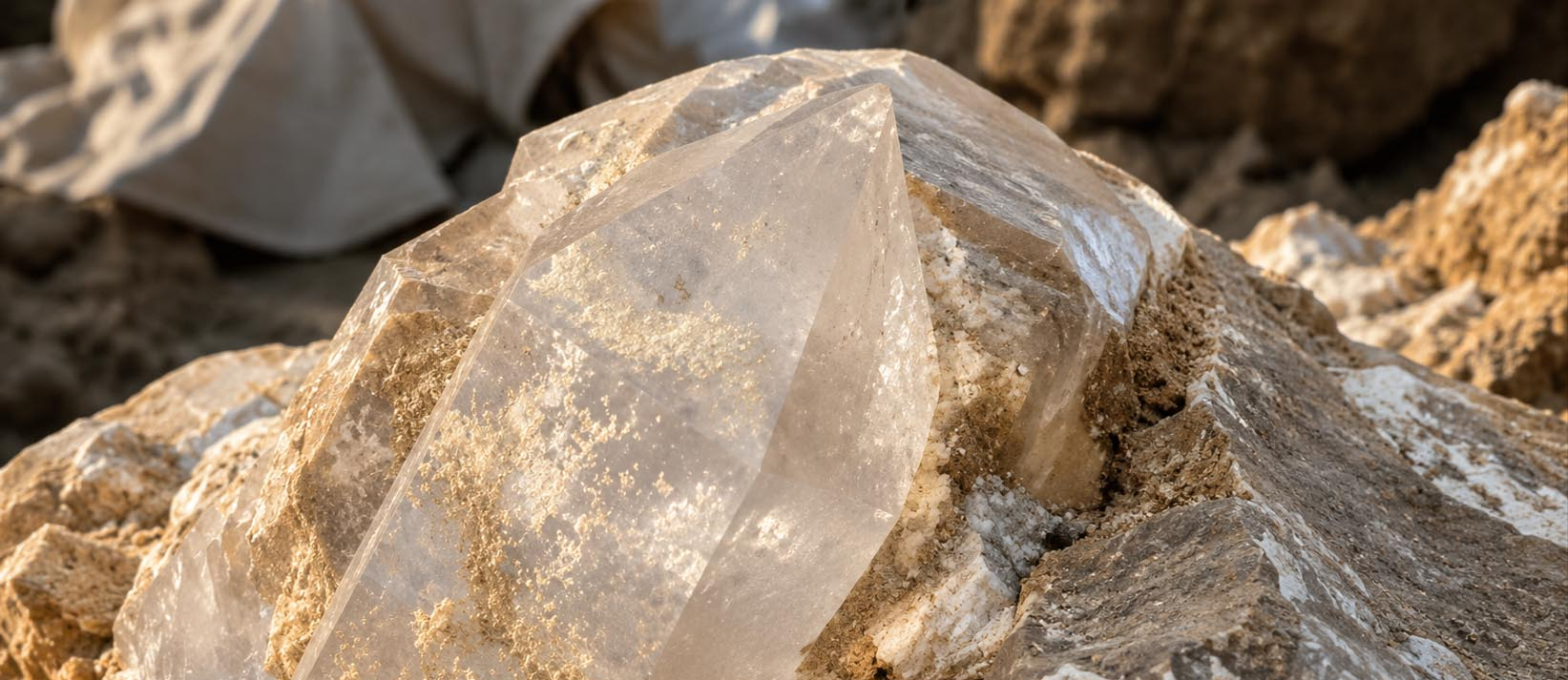
Every piece of natural Sphatik you'll ever see, a polished sphere, a mala bead, a raw crystal point, began the same way: as dissolved silica, deep inside the Earth, with nowhere to go but slowly into shape.
That process, from formless mineral content in hot fluid or molten rock to a clear, six-sided crystal you can hold in your hand, is one of the more remarkable stories in geology. It's also a slow one. The Sphatik on your shelf may have started forming before the Himalayas existed in their current form.
This article walks through that journey: where the silica comes from, the conditions that allow a crystal to grow clear rather than cloudy, and the different geological settings where Sphatik forms across India and the world.
Sphatik, like all quartz, is made of silicon dioxide (SiO₂), one of the most common chemical compounds in the Earth's crust. But having the raw ingredients available isn't enough on its own. For a clear quartz crystal to form, that silica needs to be mobile, dissolved or molten, so it can move into a space where it has room to crystallise.
This happens in a few different ways, but they share a common thread: heat. Whether it's silica dissolved in hot water moving through cracks in rock, or silica-rich melt left over from a cooling magma body, temperature is what keeps the silica in a form that can travel, settle, and slowly turn solid.
What happens next, how that silica settles and crystallises, is what determines whether the result is a clear, transparent crystal (Sphatik), a cloudy mass of quartz, or something else entirely.
Geologists generally describe quartz formation as falling into three broad settings. Natural Sphatik can come from any of these, and the specific setting often leaves clues in the crystal itself.
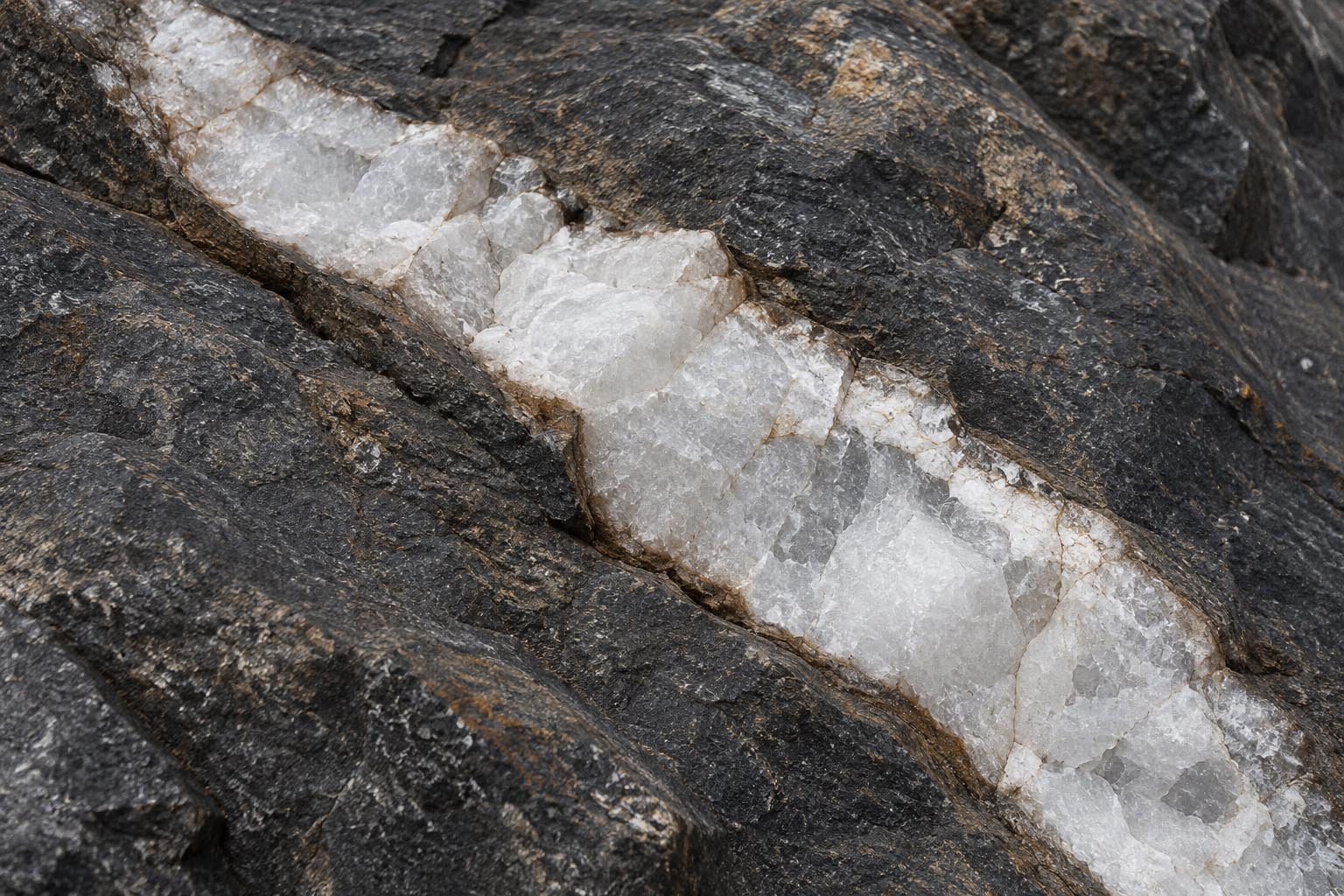
This is one of the most common ways clear quartz forms. Hot, silica-rich water, sometimes well over 100°C, moves through cracks and fractures in existing rock. As this water cools or reacts with the surrounding rock, it can no longer hold as much dissolved silica, so the silica deposits along the walls of the crack as solid quartz.
Over time, repeated episodes of this process can build up substantial quartz veins. Some of the most striking examples in India are found in central India, where ancient hydrothermal quartz veins run for kilometres and reach impressive thickness, the product of sustained geological activity over enormously long timescales.
When this process happens inside an enclosed cavity rather than a flat crack, the result can be a geode, a hollow pocket lined with crystals growing inward from the walls. Quartz formed this way can range from beautifully clear to noticeably milky, depending on how quickly the fluid cooled and how much it carried besides silica.
Deep within the Earth, large bodies of molten rock (magma) slowly cool to form granite and similar rocks. As this cooling happens, certain elements, including silica, along with water and other volatile components, tend to concentrate in the last portions of melt to solidify. These silica-and-water-rich leftovers can form pegmatites: coarse-grained rock bodies, often found as dikes or pockets within larger granite formations.
Because pegmatites cool slowly and have relatively open space for crystals to grow, they're known for producing larger, well-formed mineral crystals, including quartz. Sphatik from pegmatite settings often shows clean crystal faces and may be found alongside other minerals like feldspar and mica, which formed in the same slowly cooling environment.
Parts of Rajasthan are known for large pegmatite formations where quartz developed alongside these other minerals, a good example of how Sphatik doesn't always form in isolation, but as part of a broader mineral community shaped by the same slow cooling process.
The third major pathway doesn't start with a liquid at all, it starts with existing rock.
When rocks that already contain quartz, such as sandstone, are subjected to intense heat and pressure deep within the Earth (a process called metamorphism), their mineral structure can reorganise. Quartz grains that were once small and scattered can recrystallise into larger, more continuous crystals.
This is how quartzite forms, a metamorphic rock made primarily of recrystallised quartz. In some cases, where this recrystallisation is especially thorough and the original material was relatively pure, the result can be quartz clear enough to qualify as Sphatik.
This pathway is closely tied to mountain-building processes. Many of India's metamorphic quartz occurrences are linked to ancient periods of crustal deformation, including processes connected to the long geological history that eventually shaped the Himalayan region.
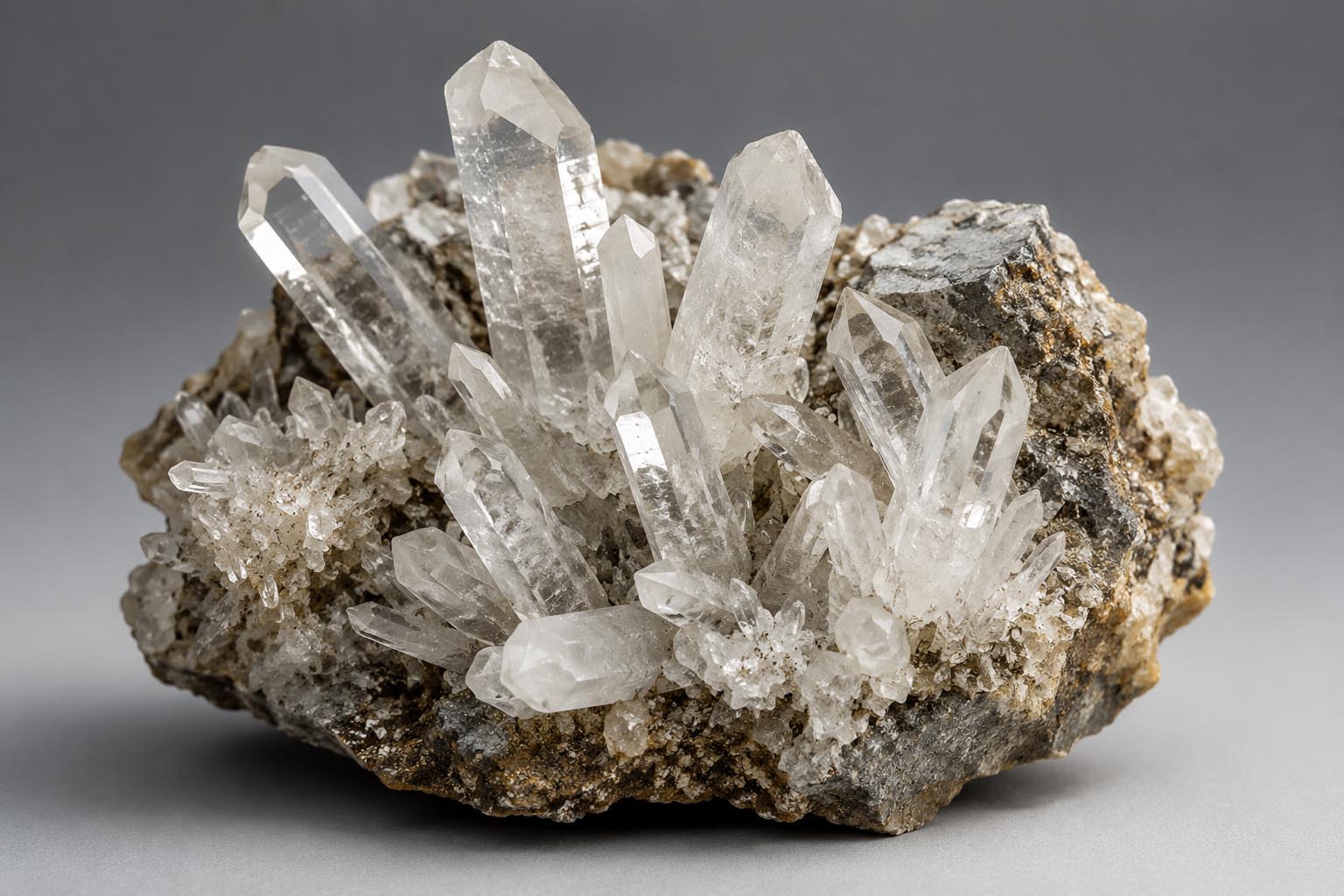
If you've ever wondered why one piece of Sphatik looks like glass while another has a slightly cloudy or milky quality, the answer lies in the conditions we've just described.
Speed matters. Crystals that grow slowly, over long, stable stretches of time, tend to be clearer. Rapid crystallisation, often seen in some hydrothermal settings, can trap tiny bubbles of fluid or gas inside the crystal, scattering light and giving the quartz a milky appearance.
Purity matters. Pure silicon dioxide, with no other elements substituting into its structure, is naturally colourless. But trace amounts of other elements, iron, aluminium, titanium, can find their way into the crystal lattice during formation. Depending on the element and how it's incorporated, this can produce colour (as in amethyst or smoky quartz) or contribute to a cloudier appearance.
Stability matters. A crystal that grows undisturbed, without sudden changes in temperature, pressure, or fluid composition, tends to develop a more uniform, continuous structure. Interruptions during growth can show up later as visible zoning, faint lines or "phantom" shapes within the crystal that mark where conditions shifted.
None of this means a clearer piece of Sphatik is somehow "more natural" than a slightly milky one. Both are the result of entirely natural processes, just under different conditions. The variation itself is part of the story each crystal tells about how it formed.
It's worth pausing on just how slow this all is.
While small quartz crystals in active hydrothermal systems can form over comparatively shorter timescales, the large, well-formed crystals typically associated with Sphatik are usually the product of sustained geological processes operating over very long periods, often measured in millions of years. Some of the major quartz-bearing formations found in India trace back to some of the oldest periods in the planet's geological history, well over a billion years in certain cases.
When you hold a piece of natural Sphatik, you're holding something that began forming long before the landscape around you looked anything like it does today. The mountains may have risen and eroded since the crystal began growing. The rivers may have changed course entirely. The crystal, slowly, quietly, kept building its structure throughout.
Understanding how Sphatik forms doesn't just satisfy curiosity, it reframes what you're looking at when you see a piece of natural quartz.
The clarity, the faint inclusions, the subtle zoning, none of these are flaws layered onto an otherwise "perfect" material. They're the record of a specific geological process: how fast it happened, how pure the source material was, and how undisturbed the crystal's environment remained while it grew.
This is also why, as covered in our guide on why no two pieces of Sphatik are exactly alike, natural Sphatik resists uniformity by its very nature. Each piece followed its own path, through its own combination of heat, pressure, fluid chemistry, and time, to become what it is.