
Fundamentals
Sphatik vs Quartz: Are They the Same?
Understanding the relationship between Sphatik and quartz — same mineral, different names, and what that really means.
Fundamentals
Understanding the relationship between Sphatik and quartz — same mineral, different names, and what that really means.
If you've read much about Sphatik, you've probably noticed the word "quartz" showing up right alongside it. So which is it, are Sphatik and quartz the same thing, or just two materials that happen to look alike?
It's a short answer with a slightly longer explanation. Here's the clear version.
Sphatik is natural clear quartz. Not a related material, not a separate category, the same mineral.
If you'd like the fuller picture, our What Is Sphatik? guide covers its composition (SiO₂), how it forms, and its physical characteristics in detail. This article focuses on two related questions that guide doesn't directly answer: why two names exist for the same thing, and how Sphatik fits within the much larger family of quartz varieties.
Think of "quartz" and "Sphatik" as operating at two different levels.
"Quartz" is the scientific term. It covers a crystal structure built from silicon and oxygen atoms in a repeating pattern, and it applies to every colour variety of the mineral, anywhere in the world.
"Sphatik" is a Sanskrit-rooted, traditional term for something clear, transparent, or crystalline. Over centuries of use in India, it became the common name specifically for clear quartz, distinguishing it from glass and from opaque or coloured stones.
Put simply: every piece of Sphatik is quartz, but not every piece of quartz would traditionally be called Sphatik. "Sphatik" narrows the broader category down to its clear, transparent form.
If Sphatik and clear quartz are the same material, why does this question come up so often? A few reasons.
Language and geography. "Quartz" shows up in scientific literature, geology textbooks, and international gemstone contexts. "Sphatik" lives mainly in Indian cultural, religious, and everyday language. Meeting both terms for the first time, in such different contexts, it's natural to assume they're different things.
The broader quartz family. Because "quartz" covers many colour varieties, amethyst, citrine, rose quartz, and more, people sometimes assume "Sphatik" must be its own distinct category, rather than simply the clear member of that same family.
Casual usage. Marketing and everyday language sometimes use "Sphatik" and "crystal" interchangeably, without clarifying the mineralogy underneath. This guide exists to cut through exactly that ambiguity.
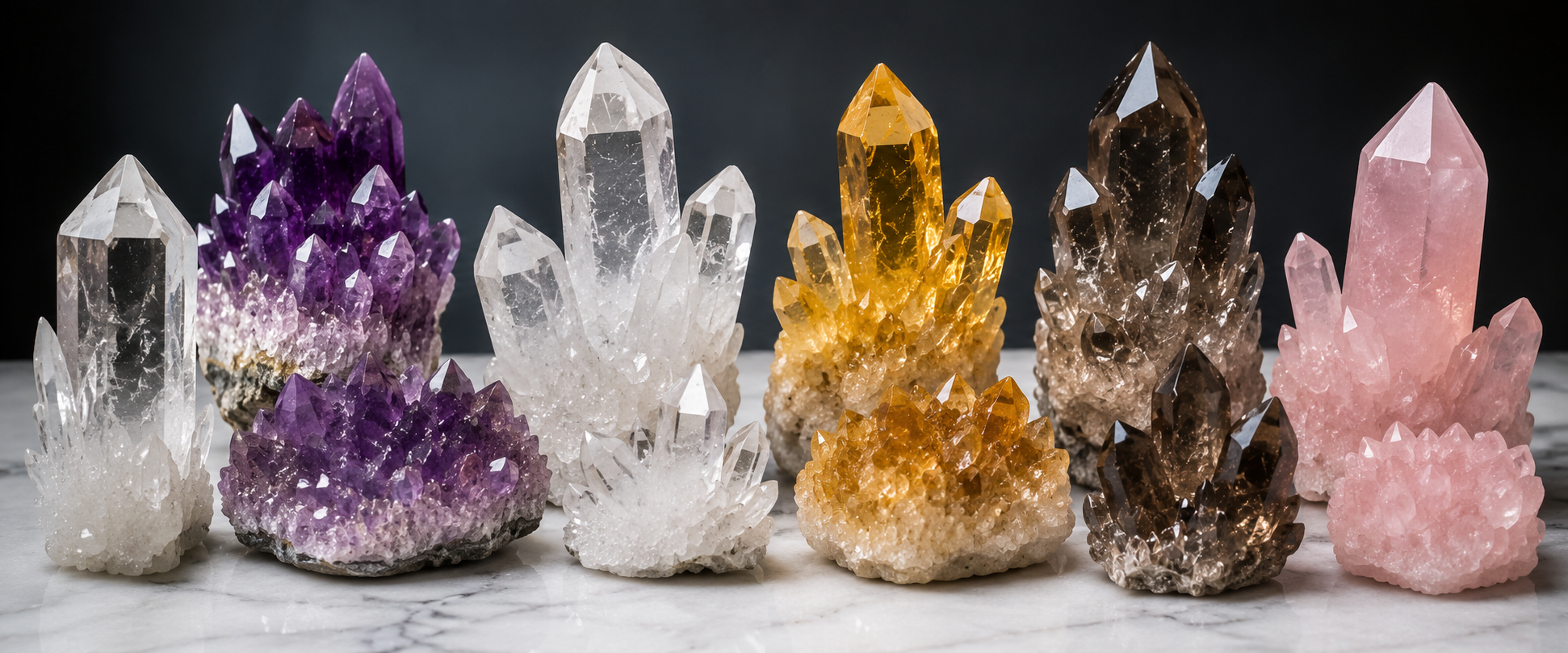
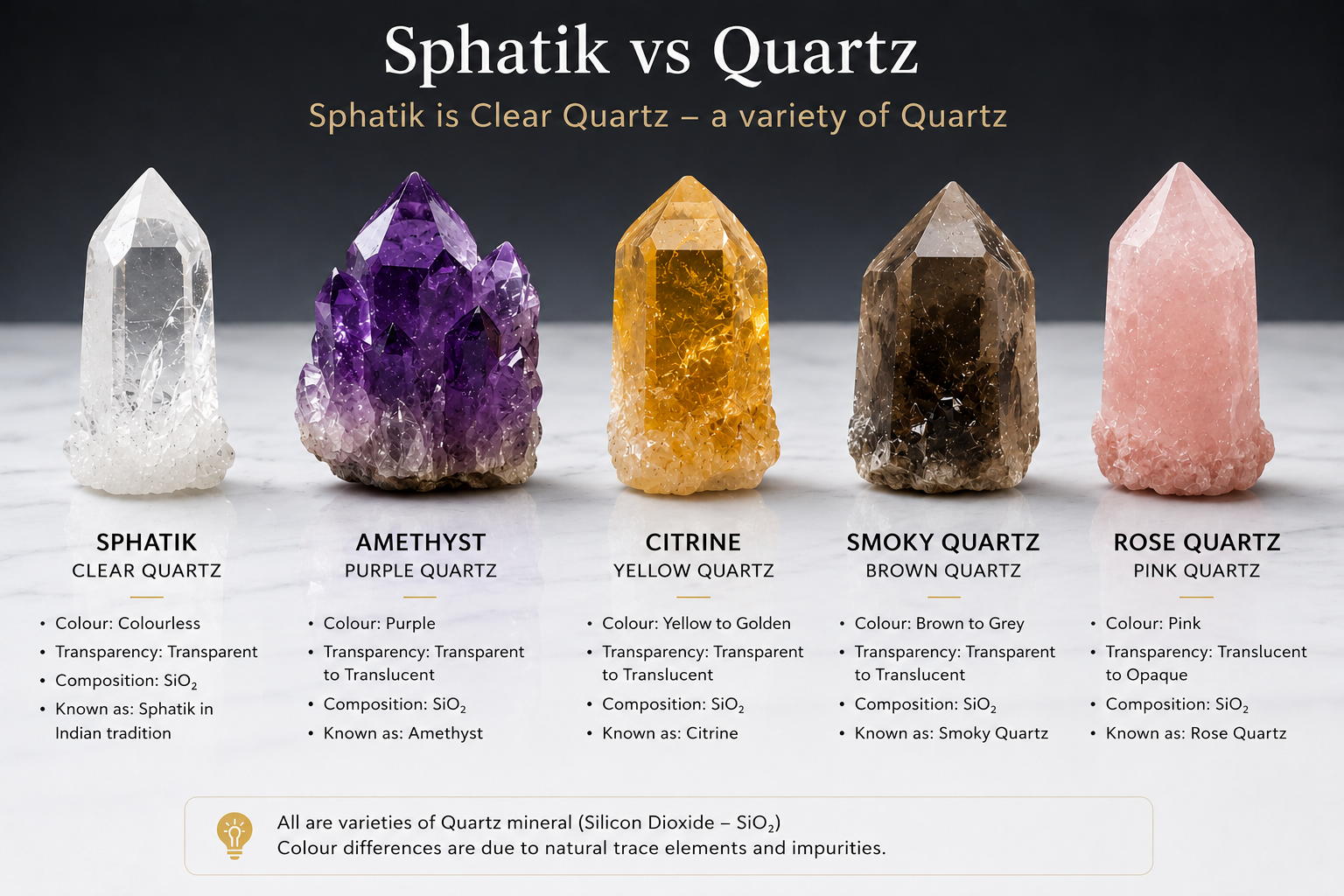
Quartz is one of the most chemically simple yet visually varied mineral groups on Earth. Every variety shares the same SiO₂ structure as Sphatik, but small differences in trace elements, radiation exposure during formation, or microscopic structure produce strikingly different colours and appearances. Understanding where Sphatik sits within this family helps clarify why so many "types" of quartz exist, and why each has carved out its own identity, separate from Sphatik, despite sharing its chemistry.
Amethyst is the purple variety of quartz, with colour caused by trace iron content combined with natural irradiation during formation. In India and many other cultures, amethyst has its own long-standing associations, often linked to calmness and introspection in popular and traditional use. Because its colour is its defining feature, amethyst is rarely, if ever, referred to as Sphatik. The two are mineralogical siblings, but culturally and visually, they occupy entirely different spaces.
Citrine is the yellow to golden-orange variety of quartz, with its colour typically arising from iron impurities in a different oxidation state than those found in amethyst. Naturally occurring citrine is relatively uncommon; much of the citrine seen commercially is produced by heat-treating amethyst, which alters the iron content's oxidation state and shifts the colour from purple to yellow. Citrine has its own traditional and decorative uses, often associated with warmth and brightness due to its colour. Like amethyst, it stands apart from Sphatik as its own named variety.
Rose quartz gets its soft pink colour from trace amounts of titanium, iron, or manganese, depending on the specific deposit, and in some cases from microscopic mineral fibres within the crystal structure itself. It's typically found in larger, more massive formations rather than as well-formed individual points, which is part of why rose quartz is more often seen as carved shapes, beads, or polished pieces rather than natural points. Its gentle colour has made it popular in jewellery and decorative items across many cultures, again as its own distinct variety.
Smoky quartz ranges from light grey-brown to nearly black, a colour caused by natural irradiation interacting with trace aluminium within the crystal structure. It's found in many of the same geological environments as clear quartz, sometimes even in the same formation, where natural radiation exposure has darkened parts of an otherwise clear crystal. Smoky quartz has its own traditional uses in jewellery and decorative carving, distinct from the clear, transparent material that Sphatik specifically describes.
Some quartz crystals form with visible needle-like inclusions of other minerals, golden rutile needles in "rutilated quartz," or dark tourmaline crystals in "tourmalinated quartz." These are still fundamentally clear quartz, SiO₂, with another mineral trapped inside during formation. Because the inclusions are the defining visual feature, these varieties are usually named and discussed separately, even though the host material is the same clear quartz that, without the inclusions, would simply be called Sphatik.
Across all these varieties, the underlying chemistry is identical: silicon dioxide, arranged in the same crystal lattice. What differs is colour, and in the Indian tradition that gave us the word "Sphatik," colour, or rather the absence of it, was the defining feature being named.
"Sphatik" described a specific visual quality: clear, transparent, glass-like crystal. A purple, yellow, pink, or smoky crystal simply didn't fit that description, regardless of its chemical identity. So as Indian language and tradition developed separate names and associations for these coloured varieties over time, "Sphatik" remained reserved for the colourless, transparent form.
This is a useful pattern to recognise: many traditional naming systems around the world describe materials by appearance and use, not by underlying chemistry. Sphatik, amethyst, citrine, rose quartz, and smoky quartz are all chemically quartz. But each name carries its own visual identity, history, and cultural context, and none of those other names are interchangeable with Sphatik, even though a mineralogist would group them all under the same heading.
In practice, this distinction matters most when you're trying to understand what you're looking at or reading about.
If a piece is described as "Sphatik" or "clear quartz" or "rock crystal" (another common English term for the same clear variety), these all point to the same material. If a piece is described as amethyst, citrine, rose quartz, or smoky quartz, it's a different-coloured member of the same broader mineral family, with its own name, appearance, and traditional associations, but it would not traditionally be called Sphatik, even though it shares Sphatik's basic chemistry.
Recognising this helps avoid two common misunderstandings: assuming Sphatik is some rare or separate substance unrelated to "ordinary" quartz, and assuming that any quartz variety can be casually relabelled as Sphatik simply because they're chemically related. Both ideas miss the actual relationship, one of shared chemistry, but distinct identity, between Sphatik and its coloured relatives.