Explore the deep spiritual significance of Sphatik crystal in Hindu tradition — from ancient scripture to temple worship — covering its role in Vedic rituals, Sri Vidya, Surya worship, and daily spiritual practice.
12 min read • Updated June 2026
In India, Sphatik has been used in spiritual practice for thousands of years.
Not as jewelry. Not as decoration. As a sacred tool — in temples, in the hands of rishis doing tapasya, in Lakshmi puja rooms across South India, in the practice of Sri Vidya, and in daily morning worship in ordinary homes.
The spiritual significance of Sphatik is not something that was decided recently. It runs through the Vedas, the Puranas, the Agamas, the Upanishads, and the living traditions of Shaivism, Shaktism, and Vaishnavism. Almost every major spiritual current in India has, at some point, placed Sphatik at the centre of its practice.
This article puts that significance in one place — what the scriptures say, what the traditions hold, and why this crystal has remained so central to Indian spiritual life for so long.
Sphatik in Ancient Scripture
The spiritual importance of Sphatik is not based on recent belief. It is found in ancient Indian scripture.
Atharva Veda — one of the four oldest sacred texts of Hinduism — references Sphatik for its ability to attract divine energies and remove negativity. This is one of the earliest written acknowledgements of Sphatik's spiritual function in Indian tradition.
Garuda Purana — one of the eighteen major Puranas — also references Sphatik's spiritual qualities. The Garuda Purana is primarily concerned with dharma, ritual purity, and what is sacred. Its mention of Sphatik places the crystal firmly in the category of sacred material.
Saiva Agamas — the foundational texts of Shaivism, which are the detailed manuals for temple worship, ritual, and spiritual practice — describe Sphatik as the most auspicious material for a Shiva Lingam. These texts also mention the use of Sphatik in Surya (Sun God) worship, where crystal lingams and yantras are used to invoke Surya's presence.
Surya Siddhanta — one of the most important ancient Indian astronomical and ritual texts — specifically refers to crystal in the context of solar worship and observation. Ancient sages understood that Sphatik has a unique relationship with light and solar energy, and this informed how it was used in Surya rituals.
Ramayana — even in India's most beloved epic, there is a reference to Sphatik. Lord Rama and Lakshmana are described as having rested on a crystal rock during their time in the forest. This small detail in the epic places Sphatik in the world of divine beings, not as something foreign to them but as a natural part of their environment.
Sphatik Across All Three Main Traditions of Hinduism
One of the most striking things about Sphatik is how widely it is used across different Hindu traditions that otherwise have distinct practices, deities, and approaches to worship.
In Shaivism
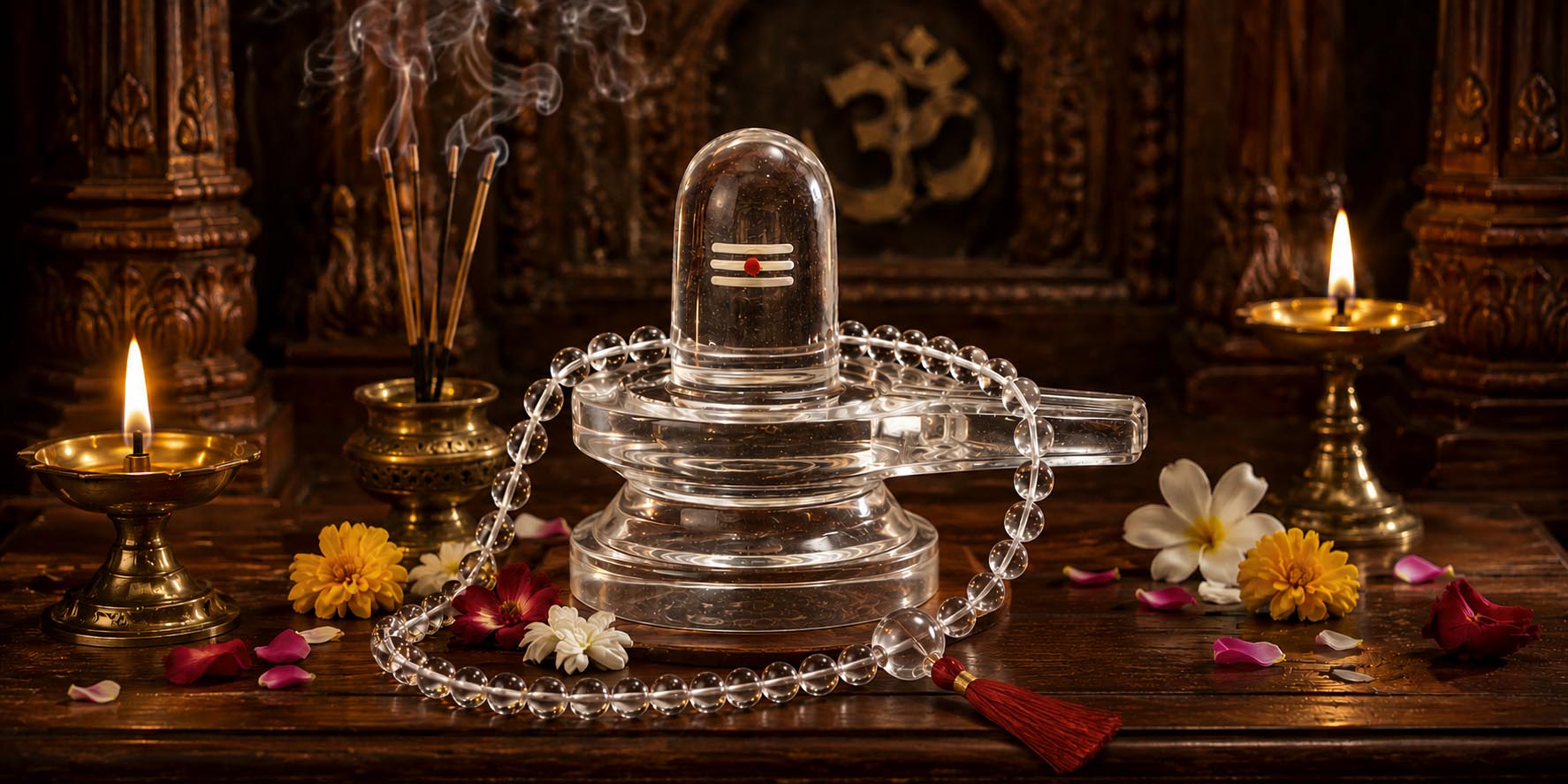
Sphatik is the most sacred material for a Shiva Lingam according to the Saiva Agamas. It represents Lord Shiva in his Nirguna (formless, attributeless) aspect — pure consciousness with no colour, no fixed form. The Sphatik Lingam enshrined in the sanctum of major Shaiva temples in South India, including the Thillai Nataraja Temple in Chidambaram, is considered one of the highest forms of Shiva's presence.
The Sphatik Mala is also the primary mala used for chanting the Panchakshari Mantra — Om Namah Shivaya — in Shaiva tradition. Ancient yogis and sadhus performing long periods of tapasya and dhyana used the Sphatik Mala as their primary spiritual tool.
In Shaktism and Sri Vidya
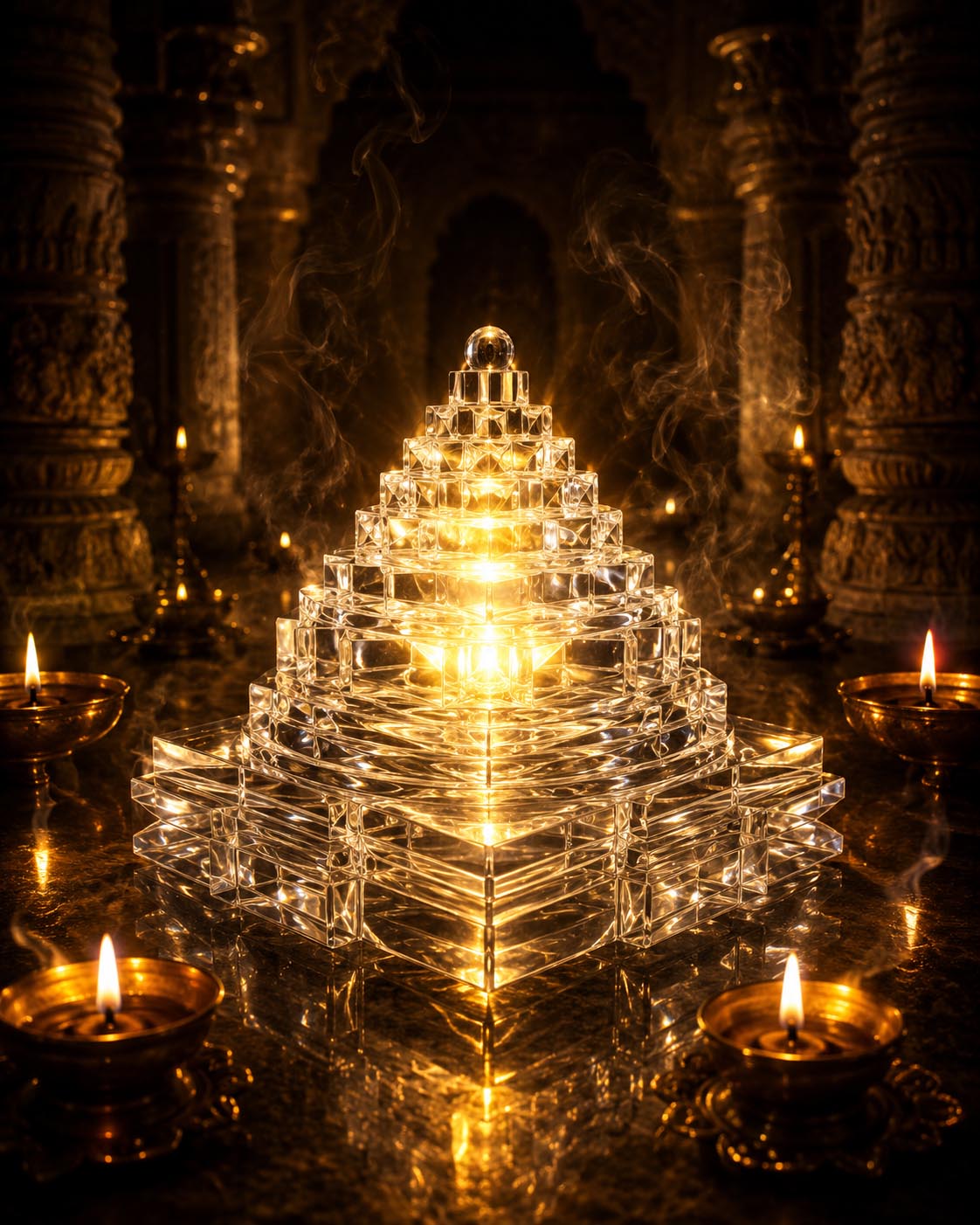
In Sri Vidya — one of the most refined and powerful traditions within Shaktism — Sphatik holds a very special place. The Sphatik Shri Yantra, carved from natural crystal, is considered the most potent form of the Shri Yantra.
The Shri Yantra is the central object of Sri Vidya practice. It represents the cosmos in its entirety and the divine feminine energy at its source. When this yantra is made from Sphatik, tradition holds that it is alive in a way that yantras made from metal or other materials are not — because Sphatik itself is considered a natural vessel of divine energy.
The Sphatik Mala is also used in Sri Vidya Sadhana for chanting the Mahalakshmi and Tripura Sundari mantras. Serious Sri Vidya practitioners specifically seek out Sphatik Mala for this practice.
In Vaishnavism
The Ramayana's reference to Rama and Lakshmana resting on a crystal rock is one connection. But the deeper Vaishnava link to Sphatik is through Goddess Mahalakshmi — the consort of Lord Vishnu. Sphatik Mala is the primary mala used for Lakshmi Sadhana and the chanting of the Lakshmi Sukta from the Rigveda.
In Vaishnavism, Sphatik is also associated with Lord Vishnu through its connection to abundance, prosperity, and the preservation of cosmic order — all of which are Vishnu's domain.
Sphatik and Surya (Sun God) Worship
One area that is less commonly known but deeply significant is Sphatik's role in Surya worship.
The Agamas specifically describe the use of Sphatik in solar worship rituals. Crystal lingams and crystal yantras were used in ancient Surya temples and rituals to invoke the Sun God's blessings. The reason is straightforward: Sphatik has a unique relationship with light. When sunlight passes through Sphatik, it refracts into a full spectrum. Ancient sages saw this as Sphatik receiving the Sun's energy and distributing it outward — a physical demonstration of what the crystal does spiritually.
This connection between Sphatik and Surya also has practical ritual implications. Offering sunlight to a Sphatik Shivling in the morning — letting the first rays of the sun fall on the crystal — is considered an act of both Shiva and Surya worship simultaneously.
Sphatik and the Sahasrara (Crown Chakra)
In the chakra system, Sphatik is associated with the Sahasrara — the crown chakra at the top of the head.
The Sahasrara is the highest energy centre in the human body. It is not associated with any specific function in the way lower chakras are. It is simply the point of opening — where the individual self meets the universal. In Vedic and Tantric tradition, the Sahasrara is the seat of pure awareness.
Practices associated with the crown chakra, as described in traditional yogic texts, emphasize simplicity and universality over complexity. This is why Sphatik — transparent, simple, without colour or inherent quality — is naturally associated with Sahasrara. It does not impose anything. It simply holds space.
Ancient yogis who used Sphatik Mala during long meditation sessions were drawn to it precisely because it did not interfere with the meditative state. It was a neutral presence that supported stillness without pulling attention toward it.
What Makes Sphatik Spiritually Unique
There are many materials used in Hindu worship — Rudraksha, Tulsi, sandalwood, gold, copper, various gemstones. Each has its own spiritual character and purpose. What makes Sphatik distinct is a combination of qualities that no other material quite matches.
It is formed entirely by nature. Not mined and cut into shape like a gemstone. Sphatik forms naturally as a crystal structure over enormous spans of time. What the earth makes without human intervention, our tradition regards as inherently sacred.
It has no colour of its own. It takes on the colour of whatever light touches it. This optical property has deep spiritual symbolism — it represents the capacity to receive and reflect without distorting. It does not impose its own nature onto the divine.
It is associated with all three of the main deities. Shiva, Mahalakshmi, and Vishnu (through Lakshmi). This is rare. Most sacred materials are strongly associated with one tradition. Sphatik cuts across all three, which is why it appears in virtually every kind of Hindu home — Shaiva, Shakta, and Vaishnava alike.
It has been used in India's highest spiritual practices. From the Vedic rishis to Sri Vidya practitioners, from ordinary daily puja to the sanctum sanctorum of major temples — Sphatik appears at every level of Indian spiritual life.
How Sphatik Is Used in Spiritual Practice Today
Across traditions and regions, Sphatik is used in several main ways:
As a Sphatik Shivling — the most complete form of Sphatik worship. Placed in the home puja room, used for daily abhishek, chanting, and Shiva devotion.
As a Sphatik Mala — 108 beads used for japa, mantra chanting, and meditation. Used for Shiva mantras (Monday), Lakshmi mantras (Friday), the Gayatri Mantra (morning practice), and Sri Vidya Sadhana.
As a Sphatik Shri Yantra — carved from natural crystal, used in Sri Vidya and Lakshmi worship. Placed in the home or business as a centre of prosperity and spiritual practice.
As a Sphatik Meru or Pyramid — used in Vastu Shastra. Placing Sphatik in the northeast corner of a home or room is traditional Vastu guidance for inviting positive energy and divine blessings.
As a Sphatik Necklace or Pendant — worn by devotees as a constant reminder of their practice and as a physical connection to their chosen deity.
The Right Way to Keep Sphatik
Sphatik does not need elaborate care. But it does need respect.
Keep it in a clean place. Do not leave it in dusty corners or cluttered spaces. If you are using it for puja, keep it on or near your altar. If you are wearing it as a mala, store it in your puja place when not in use.
Rinse it in clean water when it starts to feel dull or heavy. Some people leave it under moonlight on full moon nights to cleanse and refresh it. This is a traditional practice and a simple one.
Do not apply kumkum or haldi directly on Sphatik. Both stain the crystal permanently. Use only milk, water, Gangajal, sandalwood paste, or vibhuti.
Above all — use it. A Sphatik Mala or Shivling that sits in a box serves no one. Its spiritual significance grows with consistent use, sincere prayer, and the slow accumulation of intention over time.
Frequently Asked Questions
Sphatik is one of the most sacred materials in Indian spiritual tradition. It is mentioned in the Atharva Veda, Garuda Purana, Saiva Agamas, and Surya Siddhanta. It is used across Shaivism, Shaktism, and Vaishnavism. It represents purity, divine presence, and the formless aspect of the divine. It is used for Shiva worship, Lakshmi Sadhana, Surya worship, Sri Vidya practice, and daily meditation across India.
Yes. The Atharva Veda references Sphatik for its spiritual properties. The Garuda Purana mentions it in the context of ritual purity. The Saiva Agamas give detailed instructions for Sphatik worship. The Surya Siddhanta refers to crystal in Surya rituals. The Ramayana mentions Lord Rama and Lakshmana resting on a crystal rock. Sphatik has a long, continuous presence in Indian sacred literature.
Sphatik is primarily associated with Lord Shiva and Goddess Mahalakshmi. It is also used in Surya (Sun God) worship according to the Agamas. Through Mahalakshmi, it connects to Lord Vishnu as well. This makes Sphatik one of the very few sacred materials that is used across all three main traditions of Hinduism — Shaivism, Shaktism, and Vaishnavism.
In Sri Vidya, Sphatik holds the highest place among materials for the Shri Yantra. A Sphatik Shri Yantra is considered more spiritually potent than yantras made from metal or other materials because Sphatik is seen as a natural vessel of divine energy. The Sphatik Mala is also used for chanting Sri Vidya mantras, specifically for Tripura Sundari and Mahalakshmi practices.
The Saiva Agamas and Surya Siddhanta both describe the use of Sphatik in solar worship. Ancient sages observed that Sphatik has a unique relationship with light — when sunlight passes through it, it refracts into a full spectrum. This was seen as Sphatik receiving and distributing solar energy, making it the ideal medium for Surya rituals. Letting morning sunlight fall on a Sphatik Shivling is considered a form of both Shiva and Surya worship.
Sphatik is associated with the Sahasrara (crown chakra) in the yogic tradition. The crown chakra is the seat of pure awareness — the point of opening where individual consciousness meets the universal. Sphatik, being transparent and without inherent quality, naturally aligns with this energy centre. Ancient yogis used Sphatik Mala during deep meditation because its neutral presence supported stillness without pulling the mind's attention toward itself.
Yes. This is one of Sphatik's most distinctive qualities. It is used in Shaiva homes for Shiva worship, in Shakta homes for Lakshmi and Sri Vidya practice, and in Vaishnava homes for Lakshmi worship. Most Indian families — regardless of which deity they primarily worship — will have some form of Sphatik in their home. Very few sacred materials cross all three traditions in this way.
Keep it in a clean, respectful space — on or near your altar. Rinse with plain water periodically. Some people place it under moonlight on full moon nights for a traditional cleanse. Do not apply kumkum or haldi directly on the crystal as both stain it. Use milk, water, Gangajal, sandalwood paste, or vibhuti for abhishek. Most importantly — use it regularly. Sphatik's spiritual significance grows with consistent, sincere practice over time.